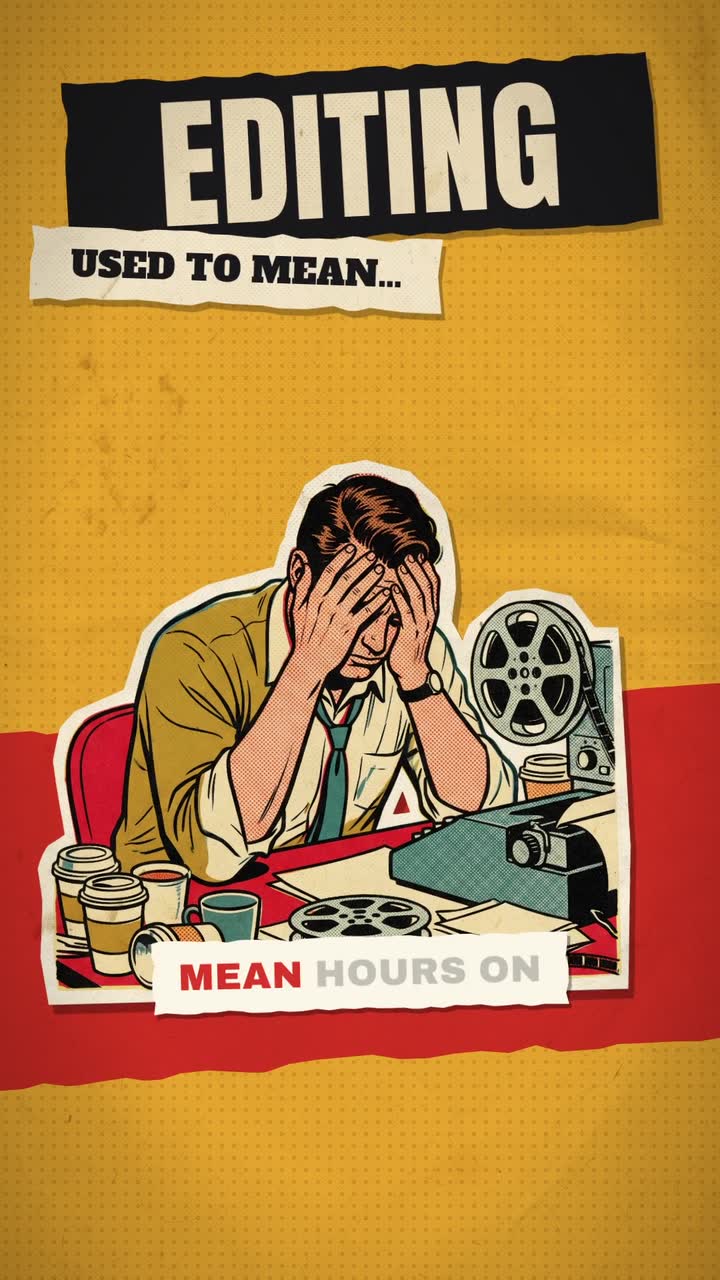
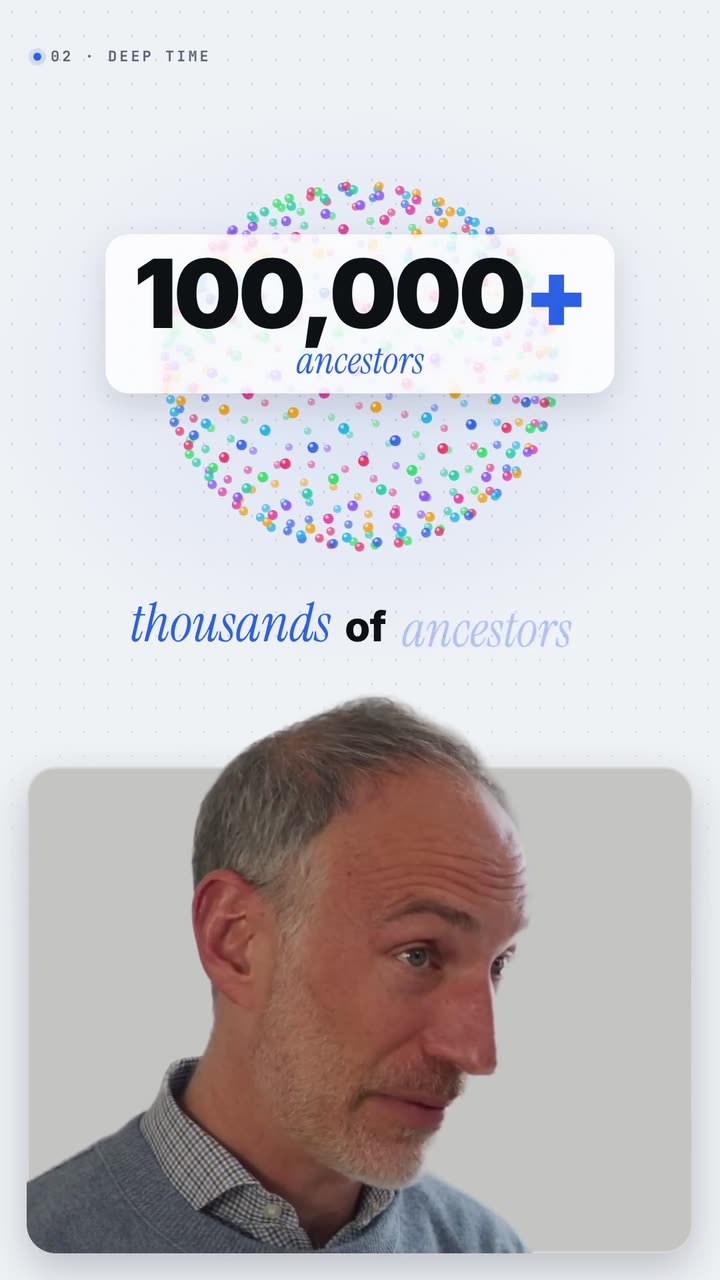
To make a faceless documentary short, pick one true story, write a script of about 150 words that opens on the strangest fact, and record or generate a calm narration. Give every sentence a visual in one consistent style (illustrations, maps, archive images), add word by word captions and quiet music, and never invent evidence.
Real outputs from the Videotto template gallery.
What a faceless documentary short looks like
The narrator is a voice, and the screen shows what the voice describes. The story is the star, so nobody needs to be on camera. That makes the format popular with people who do not want to film themselves and with channels that want to post several times a week.
The format is vertical 9:16, usually exported at 1080 by 1920. YouTube Shorts and Instagram Reels both accept videos up to 3 minutes, but one story told in 45 to 75 seconds is the common sweet spot. You need five parts, and you can bring some yourself or ask Otto to make them.
| Part | Bring your own | Or ask Otto to |
|---|---|---|
| Script | Your own research and draft | Write a draft from your topic, for you to check |
| Voice | A recording of yourself | Make a narrator voice |
| Visuals | Photos, footage, scans | Build scenes from illustrations, maps, stock footage and motion graphics |
| Captions | Your own subtitle file | Caption the narration word by word |
| Sound | Your licensed music | Add music and sound effects that fit |
Write the faceless documentary script first
A minute of calm narration is roughly 150 words. That is room for one story in four beats, and nothing else. Everything visual comes after the script is locked, because changing a line later means changing its scenes too.
- Hook (about 15 words). The strangest true fact, first. No "have you ever wondered".
- Setup (about 40 words). Who, where and when, in two or three sentences.
- Turn (about 60 words). The detail that changes everything, or the question nobody has answered.
- Ending (about 35 words). What we know now, or the best theory. Do not end on "follow for part 2" unless part 2 exists.
Worked example: a 60 second documentary short
Here is an example plan for a short about the lost colony of Roanoke, written as an illustration of the method. The narration runs about 145 words.
| Time | Narration (summary) | Visual |
|---|---|---|
| 0:00 to 0:05 | In 1590 a governor returned to his colony and found it empty, with one word carved into a post. | Close up illustration of a wooden post, the word CROATOAN drawing in |
| 0:05 to 0:18 | In 1587, more than 100 English settlers landed on Roanoke Island. Their governor, John White, sailed home for supplies. | Map of the Atlantic coast, a ship icon crossing to England |
| 0:18 to 0:30 | War with Spain kept him away for three years. | Timeline from 1587 to 1590 filling in |
| 0:30 to 0:45 | When he came back, the houses were gone. No bodies, no sign of a fight, only the carving. | Slow push across an illustrated empty clearing |
| 0:45 to 1:00 | Croatoan was the name of a nearby island and its people. Historians still argue whether the settlers went there. | Map zooming to the nearby island, a question mark, end card |
Five scenes, one map style, one accent colour. Each visual answers what the narration just said, which is what keeps people watching on mute.
Plan the visuals scene by scene
A useful rule is a new visual every 3 to 5 seconds, so a 60 second short needs roughly 12 to 20 shots. That sounds like a lot, but many are moves on the same image: a slow push, a pan to a detail, a callout appearing.
Choose one visual style and keep it for the whole video. Old book pages, archival maps, paper collage or a clean data look all work. A painting, then a stock clip, then a cartoon looks random. The examples at the top of this page each hold one look from start to end.
Match the visual to the words: a map when a place is named, a date on a timeline, a drawing of the object being described. If the narrator talks for ten seconds over one still image, add a slow move or a callout.
Faceless documentary shorts by hand vs with AI
The manual route is research in a browser, a recording in Audacity or on a phone, stock and archive images, and an edit in CapCut, Premiere Pro or DaVinci Resolve. These are rough estimates for one 60 second short.
| Task | By hand, typically | With Otto, typically |
|---|---|---|
| Research and script | 1 to 2 hours | A draft in minutes, but fact checking still takes 20 to 40 minutes |
| Voice | 20 to 30 minutes with retakes | Your recording, or a narrator voice |
| Finding visuals | 1 to 2 hours | Scenes built from your files, stock and illustrations |
| Edit, captions, sound | 1 to 2 hours | A first version to review and adjust |
The step that does not shrink is checking. Budget real time for it whichever way you work.
Accuracy rules for faceless documentaries
Documentary means people trust it. One real user wrote the rule better than we could: do not invent historical evidence, misrepresent real people, or present illustrations as real photographs. When no real image exists, use a clearly stylised illustration.
Check names, dates and numbers against at least two good sources, and say "historians think" when it is a theory. A short that is wrong gets corrected in the comments, and that is the comment people remember.
Paste this documentary prompt into Otto
Adapted from real requests Videotto users sent to Otto.
Make a 60 second vertical 9:16 documentary short about [topic].
Write the script first and show it to me before you build anything.
Open on the most surprising fact. No intro.
Style: an old history book. Aged cream paper, fine line illustrations,
maps and timelines that draw in, one deep red accent.
A calm, deep narrator voice. Big captions, word by word. Quiet music.
Don't invent evidence, and keep illustrations clearly stylised.
Then give me a title, description and tags.
Shorter faceless documentary prompts
- "Fill my whole audio with motion scenes, back to back, no gaps."
- "Give me the script."
- "Turn this into a finished paper collage explainer, with script, voice over, music and captions."
- "Add sound effects and change the pictures so it feels more dramatic."
“When exact historical imagery is unavailable, use clearly stylized editorial illustrations.”
A real Otto request, Lightly edited
Why faceless documentary shorts flop
- Too much story. One minute fits one story. Cut the background that does not serve the turn.
- A slow first sentence. Opening on a date or a definition loses people. Open on the strange part.
- Fake photos of real events. Never pass off a made up image as a real photograph.
- Loud music. The voice carries the story. Keep music well below it.
FAQ
Can faceless documentary channels be monetized on YouTube?
Faceless documentary channels can join the YouTube Partner Program like any other channel, by reaching 1,000 subscribers plus either 4,000 public watch hours in 12 months or 10 million Shorts views in 90 days. YouTube excludes mass produced or repetitive content, so each video needs original narration, research and editing.
Do I have to disclose AI-generated visuals on YouTube?
YouTube asks creators to disclose realistic altered or synthetic content that viewers could mistake for real people, places or events. Clearly stylised illustrations and an AI narrator reading your script usually fall outside that, but a realistic fake photo of a real event does not. When unsure, turn the disclosure on.
Where can I find free images for documentary shorts?
Good free sources for documentary shorts include public domain collections such as the Library of Congress, Wikimedia Commons, NASA's media library and the Internet Archive, plus stock sites like Pexels and Pixabay. Check the licence on every file, because not everything on those sites is public domain, and credit where the licence asks.
What topics work best for faceless documentary shorts?
Faceless documentary shorts work best on topics with one surprising turn that fits in a minute: unsolved mysteries, odd inventions, disasters with a strange cause, origins of everyday objects, and how places got their shape. Topics that need a lot of background or many people usually work better as longer videos.
Should I use my own voice or an AI narrator?
Your own voice builds a recognisable channel and avoids any question about synthetic narration, but it takes recording time and a quiet room. An AI narrator is faster and consistent across videos. Many faceless channels start with an AI voice and switch to their own once the format works. Either way, clarity matters more than drama.
Make your next video with Otto
Tell Otto what you want in plain words. It cuts, captions and animates the video for you.